Scupper Walker
Where the Crawdads SingScupper Walker is a Barkley Cove shrimper and the father of Tate Walker. A large, red-haired man whose life is shaped by physical work and family loss, he raises Tate through shared labor, meals, and frank advice. His care is practical and outspoken, but not untouched by the town’s prejudices: when gossip links Tate to Kya Clark, Scupper warns his son even as he says he does not accept the stories about her.
Identity and Background
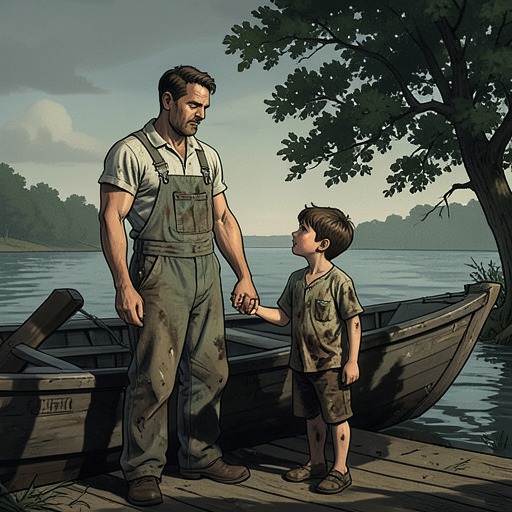
Scupper works aboard his shrimp boat, The Cherry Pie, and is known in the village by the name Scupper. The narrative first shows him returning from sea with the boat’s wide net-wings rocking in the swells and a cloud of gulls following the catch. He greets Tate on the wharf, tosses him a line, and welcomes him aboard. The crew unloads shrimp into crates while Scupper carries three wire crates at a time across the plank. His height, mountain-like shoulders, bear-sized fists, and split, chapped knuckles register a body accustomed to demanding work.
His family history reaches back to an ancestor who emigrated from Scotland and was shipwrecked off the North Carolina coast in the 1760s. The sole survivor, that ancestor swam ashore on the Outer Banks, married, and fathered thirteen children; many Walkers trace their roots to him. Scupper and Tate, however, keep mostly to themselves rather than joining the extended family’s Sunday picnics as often as they once did. The account links that withdrawal to the absence of Scupper’s wife and daughter, Carianne Walker, who appear together in a photograph at home.
Work and the Household
Scupper’s relationship with Tate is repeatedly expressed through doing things together. After the catch is unloaded, he declines the crew’s invitation to join them for beer, saying he has boat work to finish before going home. In the wheelhouse he puts a Miliza Korjus record on the player strapped to the counter and turns up the volume; below deck, in the engine hold, Tate passes him tools as he greases parts and tightens bolts under a dim bulb. The two work until the boat is hosed down, the nets tied, and the lines secured. Opera continues to rise above the labor, making music part of an ordinary working evening rather than an escape from it.
At home, Scupper and Tate carry that shared routine into the kitchen. Tate forms hamburger patties and prepares tomatoes and baked beans while a photograph of Scupper’s wife and Carianne hangs beside the window. He looks away from the picture and imagines the family meal that might have been: his mother basting a chicken, Carianne cutting biscuits. The narration gives Tate’s private thought that, if not for his father, the women would still be there, but does not explain the circumstances behind their absence. At dinner, Scupper’s burgers are blackened outside but juicy and thick; father and son eat quietly before Scupper asks about school. The meal and the silence make their domestic closeness tangible without resolving the grief around the empty places.
Poetry, Music, and Manhood
When Tate says his English class requires each student to read a poem aloud, Scupper offers The Cremation of Sam McGee by Robert Service, a poem he remembers reciting to his children. It was his wife’s favorite, and she laughed every time he read it. Tate looks down and pushes his beans around when his mother is mentioned, so Scupper’s choice brings family memory into a conversation about school. He admits he no longer knows the poem by heart, then retrieves it and reads to his son.
Scupper also rejects the idea that poetry is unmanly. He points to its range, from love poems to humor, nature, and war, and insists through his example that its purpose is to make a person feel. He has often taught Tate that a real man can cry without shame, read poetry with his heart, feel opera in his soul, and do what is necessary to defend a woman. The formulation joins emotional openness to action: sensitivity is not a retreat from responsibility but part of what makes responsibility possible. His love of opera, willingness to read aloud, and direct instruction give that principle a lived form.
Fatherhood and His Response to Kya
Scupper’s concern for Tate includes both encouragement and caution. After he and Tate have spent the day scraping barnacles until their arms burn, they go to the Barkley Cove Diner. Scupper observes that the work has taken time from his son: Tate missed the previous fall’s homecoming dance, and Scupper does not want him to miss everything in his final year. He asks whether Tate will invite someone to a dance at the pavilion. Tate says he may go but has no one he wants to ask.
Scupper then raises the gossip that Tate is seeing the girl in the marsh. He says he does not put much stock in idle talk and does not believe all the stories about Kya, who is probably nice, but warns Tate against starting a family too young. Tate hears the tension in that warning: although Scupper disclaims belief in the rumors, his caution still treats their sexual insinuations as a risk worth raising. Tate answers by defending Kya as innocent and explaining that he has been visiting her to teach her to read because people in town are cruel to her and she could not attend school. Scupper accepts the explanation, calls the teaching a good thing, and says that warning his son is part of a parent’s job. His response is neither a rejection of Tate’s care for Kya nor a complete escape from the assumptions circulating around her; it shows affection and responsibility operating within a community shaped by rumor.
Narrative Role
Scupper offers Tate a model of adult care that is distinct from the town’s talk: he works beside his son, asks whether school and social life are narrowing around work, shares music and poetry, and explains his warnings as parental duty. The model is warm but imperfect. His talk about Kya begins with the same gossip that Tate must challenge, so the scene lets paternal concern and social prejudice occupy the same conversation. By accepting Tate’s account of why he visits her, Scupper makes room for a more generous understanding, while Tate’s defense exposes the distance between the town’s reputation for Kya and her actual need for instruction and kindness.